Engineer-to-order means every order costs engineering hours again, even the enquiry that closely resembles last month's. Configure-to-order means the thinking is done up front and the order merely selects. In logistics this is known as moving the customer order decoupling point. This page describes the route that actually works.
Where engineer-to-order holds you back
- Every order costs engineering hours again, investigating, drawing and calculating, over and over.
- Engineering is the queue, orders wait not for production but for a free hour with your best people.
- Knowledge is spread across experienced engineers, earlier quotes, drawings and spreadsheets. That often means the person with the overview must help before sales can prepare a quote.
- Growth means hiring, revenue runs into engineering capacity, not into the market.
Two routes, and only one arrives
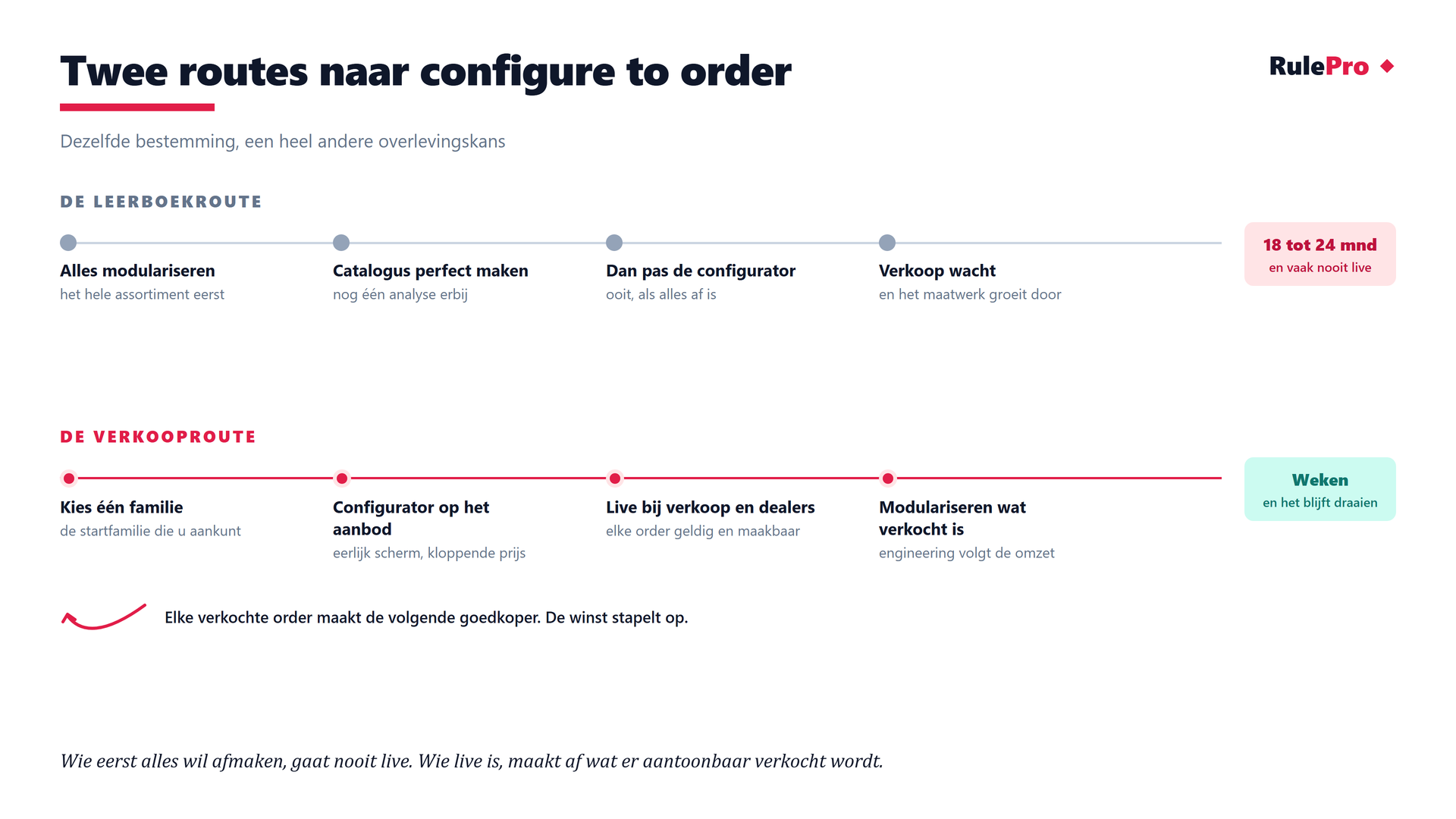
The textbook route, modularise the entire portfolio, perfect the catalogue, then build the configurator, sounds sensible but often gets stuck in analysis and elaboration, while custom work keeps growing. The sales route inverts it. Pick one product, point the configurator at what you want to sell, go live, and modularise what sells. Every sold order makes the next one cheaper.
For your starter product, pick not your prettiest or newest but what sells most often. That is where every module pays for itself fastest.
Sixty to eighty percent is already identical
Look at your order history. In the companies we see, 60 to 80% of every order turns out to be the same. This too is a rule of thumb from practice, not a research figure. Feel free to check it against your own orders. Beware. Much of what looks like variety is accidental variety, three engineers who solved the same problem three ways. That is not customer demand; that is history. Real customer variety lives in a handful of positions, and a variety analysis points them out. Build choices there; the rest becomes standard.
The shift in engineering (and why it is not free)
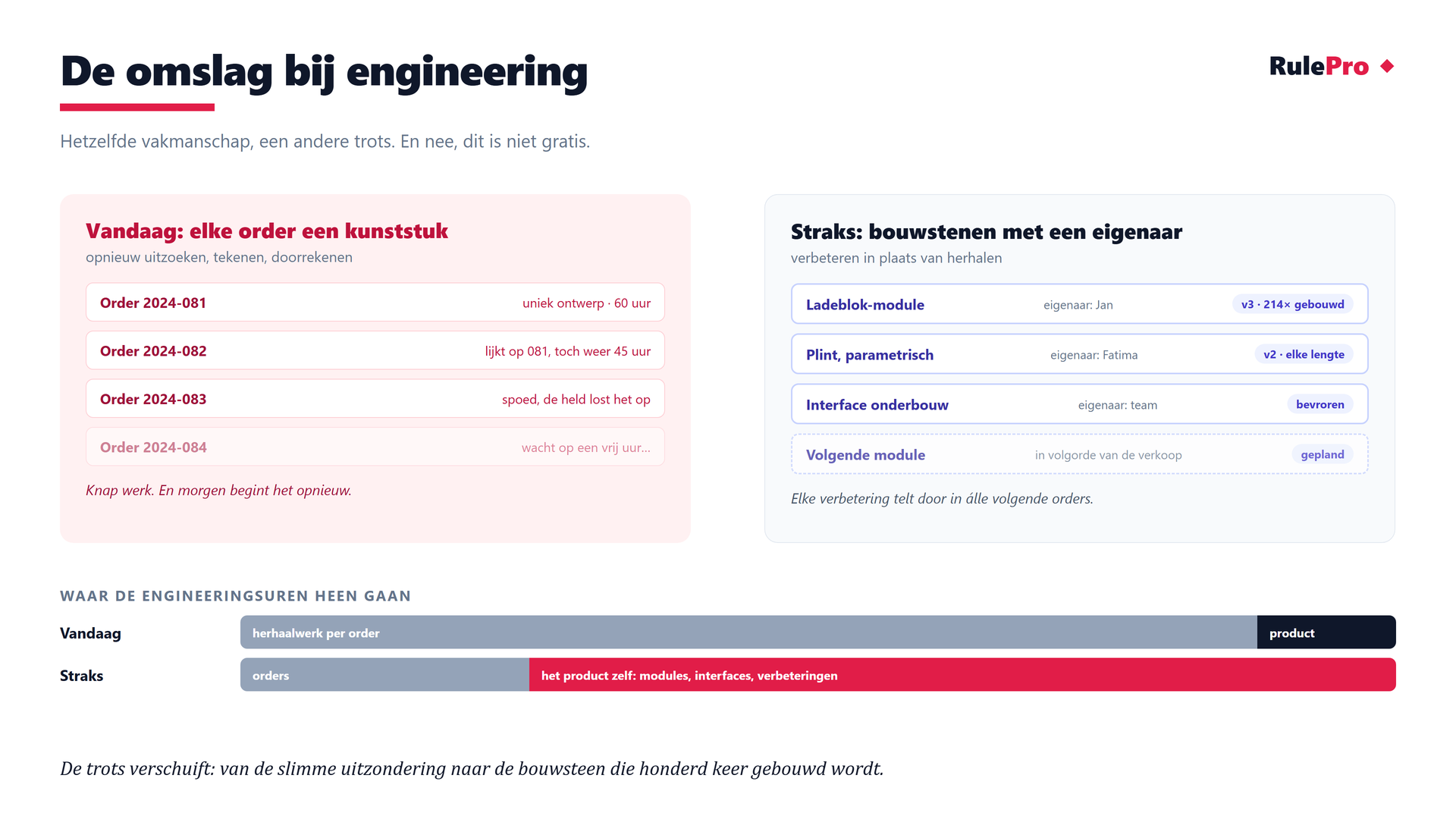
This takes time and attention from engineering. Done means done (module with drawing, BOM, interface and documentation), reuse becomes the norm, every module gets an owner, and it costs months of capacity alongside running orders. Fail to plan for it and you get good intentions instead of modules. The reward is that pride shifts from the clever exception to the building block built a hundred times.
The bottleneck can be in engineering and sales
Engineering and sales can both determine lead time. A sales career is built on saying yes, and configure-to-order can sometimes feel like selling no. Ignore that and custom work returns outside the configurator. The answer lives on the sales & dealers page. The configurator gives sales the fastest yes in the market.
What does it deliver? The honest numbers
Ranges from public CPQ and modularisation research. Every source is on the numbers page. CPQ can free up time in quotes, changes and recurring ETO work. Engineering can use that capacity for product improvement and to further standardise products that sell often. Building up costs capacity first, and the gains land where the configurator is live.